
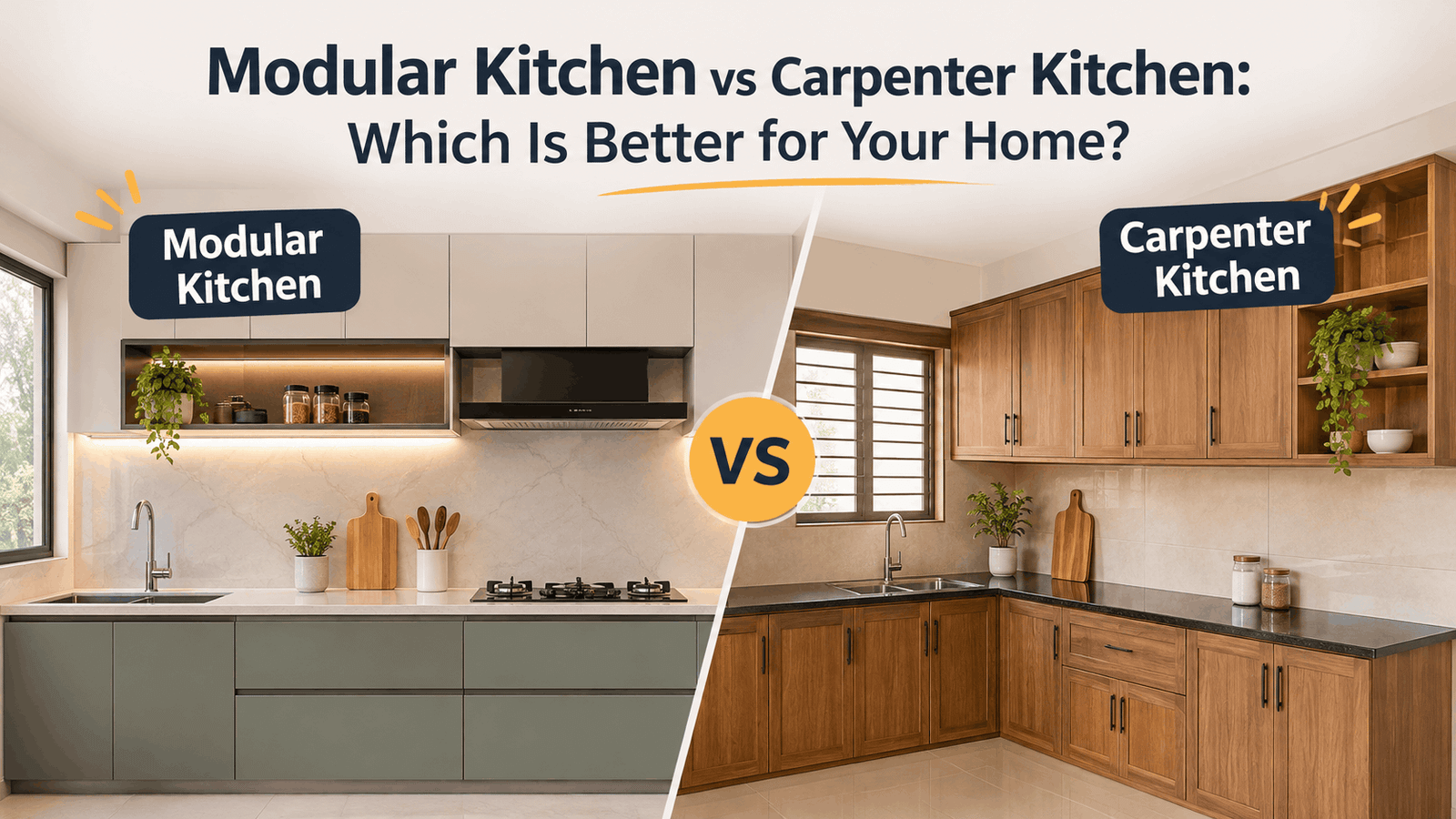
When planning a new kitchen, one of the biggest decisions homeowners face is choosing between a modular kitchen vs carpenter kitchen.
Both options can create a functional and attractive kitchen, but they differ in design process, manufacturing, installation, customization, storage solutions, hardware, finish, maintenance and overall project management.
A modular kitchen is generally manufactured in modules and assembled at the site, while a carpenter-made kitchen is typically built and fitted at the site according to the available space and design requirements.
So, which one is better?
The answer depends on your budget, kitchen requirements, preferred design, timeline and expectations regarding finish and customization.
This guide explains the difference between a modular kitchen and carpenter kitchen so you can make a more informed decision.
What Is a Modular Kitchen?
A modular kitchen consists of pre-designed and manufactured cabinet modules that are assembled and installed at the kitchen site.
The modules can include:
- Base cabinets
- Wall cabinets
- Tall units
- Drawers
- Corner units
- Pantry units
- Appliance units
- Storage accessories
The kitchen can be designed according to the available space and selected layout.
Common layouts include:
- Straight kitchen
- L-shaped kitchen
- U-shaped kitchen
- Parallel kitchen
- Island kitchen
One of the main advantages of modular kitchens is that the design, materials, hardware and modules can generally be planned before manufacturing begins.
What Is a Carpenter Kitchen?
A carpenter kitchen is generally built on-site by a carpenter or woodworking team.
Instead of receiving factory-made cabinet modules, the cabinets are constructed, assembled and fitted at the property.
A carpenter can work according to the dimensions and conditions of the existing kitchen.
Typical components may include:
- Base cabinets
- Wall cabinets
- Shelves
- Drawers
- Shutters
- Countertop support
- Storage units
The materials and hardware used depend on the carpenter, contractor and specifications agreed with the homeowner.
Modular Kitchen vs Carpenter Kitchen: Key Difference
The biggest difference is the way the kitchen is designed, manufactured and installed.
| Feature | Modular Kitchen | Carpenter Kitchen |
| Manufacturing | Mostly factory/module based | Mainly site-based |
| Installation | Modules assembled at site | Cabinets constructed/fitted at site |
| Design planning | Usually detailed before production | Can evolve during site work |
| Customization | High, within modular systems | High, especially for site-specific work |
| Finish consistency | Generally more controlled | Depends heavily on workmanship |
| Hardware options | Wide range of specialized hardware | Depends on selected hardware |
| Installation time | Often more predictable | Can vary with site work |
| Maintenance | Individual modules/components can be serviced or replaced | Repairs may require site work |
| Quality consistency | More standardized manufacturing | Depends strongly on carpenter skill |
| Best suited for | Planned, design-led kitchens | Highly site-specific/custom work |
The exact experience depends on the manufacturer, carpenter, materials and project specifications.
Modular Kitchen vs Carpenter Kitchen: Which Is More Customizable?
Both can be customized, but the nature of customization is different.
Modular Kitchen Customization
A modular kitchen can be customized through:
- Cabinet dimensions
- Layout
- Shutter colours
- Finishes
- Hardware
- Storage accessories
- Drawer configurations
- Tall units
- Corner solutions
- Appliance integration
The design is usually finalized before manufacturing.
Carpenter Kitchen Customization
A carpenter can make cabinets directly according to site conditions.
This can be useful when:
- Walls are irregular
- Existing structures need to be retained
- Unusual spaces need to be used
- The homeowner wants site-level modifications
Therefore, carpenter kitchens can offer considerable flexibility for unusual spaces.
Modular Kitchen vs Carpenter Kitchen: Which Has Better Finish?
Finish quality depends on the materials and workmanship used.
A modular kitchen manufactured in a controlled production environment can provide greater consistency in:
- Panel dimensions
- Edge finishing
- Shutter alignment
- Drilling
- Hardware installation
- Surface finishing
With a carpenter kitchen, the final finish depends more heavily on the carpenter’s skills and the quality of materials and tools used at the site.
A highly skilled carpenter can also produce a good-quality kitchen.
Therefore, it is not accurate to say that every modular kitchen will have a better finish than every carpenter kitchen.
The manufacturer, materials and workmanship matter.
Modular Kitchen vs Carpenter Kitchen: Which Is More Durable?
Durability depends on several factors rather than simply whether the kitchen is modular or carpenter-made.
Important factors include:
- Cabinet material
- Material thickness
- Moisture exposure
- Edge sealing
- Hardware quality
- Installation quality
- Kitchen usage
- Maintenance
For example, a well-built plywood kitchen with good hardware can perform well whether it is manufactured as a modular system or constructed by a skilled carpenter.
When comparing kitchens, ask for the exact board material, grade, thickness and hardware specifications.
Modular Kitchen vs Carpenter Kitchen: Which Is More Affordable?
There is no universal answer.
The total cost depends on:
- Cabinet material
- Shutter finish
- Hardware
- Accessories
- Countertop
- Number of cabinets
- Kitchen size
- Layout
- Installation
- Customization
A carpenter kitchen may appear less expensive initially because homeowners can select materials and hardware individually.
However, additional site work, wastage, labour, hardware and finishing can affect the final cost.
A modular kitchen may have a higher initial quotation but can include more structured design, manufacturing, hardware and installation components.
The best approach is to compare complete quotations with identical specifications.
Modular Kitchen vs Carpenter Kitchen: Which Is Faster?
A modular kitchen can have a more predictable installation process because cabinet components are manufactured before installation.
Once the site is ready, modules can be brought to the property and assembled.
A carpenter kitchen is generally constructed at the site, so the project can involve:
- Cutting
- Assembly
- Sanding
- Shutter preparation
- Hardware installation
- Painting or finishing
- On-site adjustments
The timeline can therefore vary depending on the complexity of the kitchen and the number of workers involved.
However, the actual timeline depends on the manufacturer or carpenter and the project scope.
Modular Kitchen vs Carpenter Kitchen: Hardware
Hardware is one of the most important differences homeowners should examine.
A modular kitchen can be designed with specialized hardware such as:
- Soft-close hinges
- Drawer channels
- Tandem drawers
- Bottle pull-outs
- Corner mechanisms
- Pantry systems
- Lift-up shutters
- Waste-bin systems
A carpenter kitchen can also use these products, provided the correct hardware is selected and installed properly.
Therefore, hardware quality is not automatically determined by whether the kitchen is modular or carpenter-made.
Always ask for the exact hardware brand, model and warranty.
Modular Kitchen vs Carpenter Kitchen: Storage
Modern modular kitchens can offer a wide variety of organized storage solutions.
These can include:
- Base Cabinets: Useful for pots, pans and larger kitchen items.
- Wall Cabinets: Suitable for frequently used utensils and lightweight storage.
- Tall Units: Useful for pantry storage and appliances.
- Corner Units: Designed to improve the usability of difficult corner spaces.
- Drawer Systems: Useful for cutlery, utensils and smaller items.
A carpenter can also create customized storage, but specialized mechanisms need to be specified and installed correctly.
Modular Kitchen vs Carpenter Kitchen: Maintenance
Maintenance depends on construction quality and materials.
Modular Kitchen
One advantage of modular construction is that individual cabinet components may be easier to remove, service or replace.
For example, a damaged shutter or hardware component can potentially be replaced without reconstructing the entire kitchen.
Carpenter Kitchen
Repairs are generally carried out at the site.
If a cabinet has been constructed as a fixed structure, modification or replacement may require more on-site work.
However, this depends on the construction method.
Modular Kitchen vs Carpenter Kitchen: Which Is Better for Small Kitchens?
For a small kitchen, both options can work.
A modular kitchen can be useful when you want:
- Organized storage
- Pull-out accessories
- Integrated appliances
- Planned cabinet dimensions
- A clean contemporary appearance
A carpenter kitchen can be useful when:
- The space has unusual dimensions
- Walls are irregular
- Existing structures need to be retained
- Extensive site-level customization is required
The correct choice depends on the space and the desired result
Modular Kitchen vs Carpenter Kitchen for Indian Homes
Indian kitchens often have specific requirements related to:
- Pressure cookers
- Large utensils
- Spice storage
- Masala boxes
- Gas cylinders
- Chimneys
- RO systems
- Mixers
- Microwave ovens
- Heavy cookware
- Multiple cooking appliances
When designing an Indian kitchen, storage should therefore be planned around the actual cooking habits of the household.
Both modular and carpenter kitchens can accommodate these requirements.
The important point is to communicate your storage requirements before construction begins.
Modular Kitchen vs Carpenter Kitchen: Which Is Better for a New Home?
For a new home where the kitchen layout and dimensions are already known, a modular kitchen can provide a structured design and manufacturing process.
You can finalize:
- Kitchen layout
- Cabinet configuration
- Material
- Finish
- Hardware
- Accessories
- Appliances
before manufacturing.
A carpenter kitchen can also work well when the homeowner wants extensive on-site customization.
Modular Kitchen vs Carpenter Kitchen: Which Is Better for Renovation?
For renovation projects, the choice depends on the existing conditions.
A modular kitchen may be suitable when the homeowner wants to replace the existing cabinets with a new planned system or in future wants to reuse their existing kitchen in a new space .
A carpenter may be useful when the renovation involves unusual modifications or integration with existing structures.
Before choosing either option, inspect:
- Plumbing
- Electrical points
- Wall condition
- Flooring
- Ceiling
- Existing appliances
- Gas connection
- Sink position
This can help avoid unexpected work later.
Pros and Cons of Modular Kitchen
Advantages
- Structured design process
- Wide range of finishes
- Specialized storage accessories
- Modern hardware options
- Consistent manufacturing
- Faster site installation in many projects
- Easier planning before production
- Suitable for contemporary kitchen designs
Disadvantages
- Customization may have system limitations
- Premium finishes and hardware can increase cost
- Changes after manufacturing may be more complicated
- Final price depends on the selected specifications
Pros and Cons of Carpenter Kitchen
Advantages
- High site-level flexibility
- Can accommodate unusual spaces
- Easy to make certain on-site modifications
- Materials and hardware can be selected separately
- Can work well for highly customized requirements
Disadvantages
- Quality depends heavily on workmanship
- Site work can take longer
- Finish consistency can vary
- Project supervision may be required
- Specialized hardware may need careful installation
- Final cost can change as site requirements evolve
Modular Kitchen vs Carpenter Kitchen: Complete Comparison
| Factor | Modular Kitchen | Carpenter Kitchen |
| Design | Planned before production | Often developed around site work |
| Manufacturing | Factory/module based | Mainly on-site |
| Customization | High | Very high for site-specific requirements |
| Finish consistency | Generally more standardized | Depends on workmanship |
| Installation | Usually structured | More site-dependent |
| Hardware | Wide specialized options | Depends on selected hardware |
| Storage accessories | Easily integrated | Can be added if properly planned |
| Repairs | Components can often be serviced/replaced | Usually repaired on-site |
| Timeline | Often more predictable | Can vary |
| Cost | Depends on complete specification | Depends on materials, labour and site work |
| Best for | Planned modern kitchens | Highly site-specific kitchens |
How to Choose Between Modular and Carpenter Kitchen
Before making your decision, consider these questions:
1. What Is Your Budget?
Set a realistic budget for cabinets, hardware, countertop, appliances and installation.
2. How Much Customization Do You Need?
If your kitchen has unusual dimensions, site-level customization may be important.
3. What Finish Do You Want?
Compare laminate, acrylic, PU, veneer and other finishes according to your budget and maintenance requirements.
4. What Hardware Do You Need?
Decide whether you need soft-close drawers, pull-outs, corner mechanisms or pantry systems.
5. How Quickly Do You Need the Kitchen?
Discuss the complete timeline before finalizing the project.
6. Who Will Handle the Project?
Check whether you are dealing with a manufacturer, designer, contractor or individual carpenter.
7. What Warranty Is Provided?
Ask for written warranty terms for cabinetry, hardware and other components.
What Should You Check Before Choosing a Modular Kitchen Company?
If you choose a modular kitchen, do not compare companies only on price.
Check:
- Cabinet material
- Material thickness
- Shutter specification
- Hardware brand
- Hardware warranty
- Accessories
- Countertop
- Installation
- Project timeline
- Warranty
- After-sales service
Anupam Kitchen own guidance similarly recommends checking materials, hardware, warranty, manufacturing capability and what is included in the quotation before selecting a modular kitchen manufacturer.
How Anupam Kitchen Can Help With Modular Kitchen Planning
For homeowners considering a modular kitchen, Anupam Kitchen provides modular kitchen design and planning options.
The right kitchen should be planned around:
- Available space
- Kitchen layout
- Storage requirements
- Material preferences
- Shutter finish
- Hardware
- Appliances
- Budget
Instead of selecting a kitchen only by appearance or advertised price, homeowners should compare the complete specification and expected functionality.
Frequently Asked Questions
Q1. Is a modular kitchen better than a carpenter kitchen?
Neither option is universally better. A modular kitchen can offer structured manufacturing, organized storage and predictable installation, while a carpenter kitchen can provide extensive site-level customization. The right choice depends on your requirements.
Q2. Which is cheaper, a modular kitchen or carpenter kitchen?
There is no fixed answer. The final cost depends on materials, hardware, accessories, labour, countertop, layout and installation. Compare complete quotations rather than only the initial price.
Q3. Which kitchen lasts longer?
Durability depends on material quality, construction, hardware, moisture protection, installation and maintenance. Both modular and carpenter kitchens can be durable when properly designed and constructed.
Q4. Is a modular kitchen more customizable?
Modular kitchens offer extensive customization through cabinet configurations, finishes, hardware and accessories. Carpenter kitchens may provide greater flexibility for unusual site conditions and on-site modifications.
Q5. Is a carpenter kitchen good for an Indian kitchen?
Yes. A carpenter-made kitchen can be designed around Indian cooking requirements, including large utensils, spices, appliances and storage needs. However, modular kitchens generally offer better finishing consistency, precision manufacturing, organised storage and easier replacement of individual units.
Q6. Which kitchen is faster to install?
A modular kitchen can generally have a more structured installation process because modules are manufactured before installation. The actual timeline depends on the project and manufacturer.
Q7. Can carpenter kitchens use modular kitchen hardware?
Yes. Specialized hinges, drawer systems and pull-outs can also be installed in carpenter-made kitchens when the cabinets are designed correctly for them.
Q8. Which is easier to maintain?
Modular kitchens can make certain component-level replacements easier, while carpenter kitchens are generally repaired on-site. Maintenance ultimately depends on construction quality and materials.
Q9. Should I choose a modular or carpenter kitchen for a small kitchen?
Both can work. A modular kitchen can provide organized storage and specialized accessories, while a carpenter kitchen may be useful when the space requires extensive site-specific customization.
Conclusion
Choosing between a modular kitchen vs carpenter kitchen depends on more than the initial price.
A modular kitchen can be a strong option if you want a planned design, organized storage, modern hardware, consistent manufacturing and a structured installation process.
A carpenter kitchen can be suitable if your priority is extensive on-site customization, unusual dimensions or flexibility during construction.