
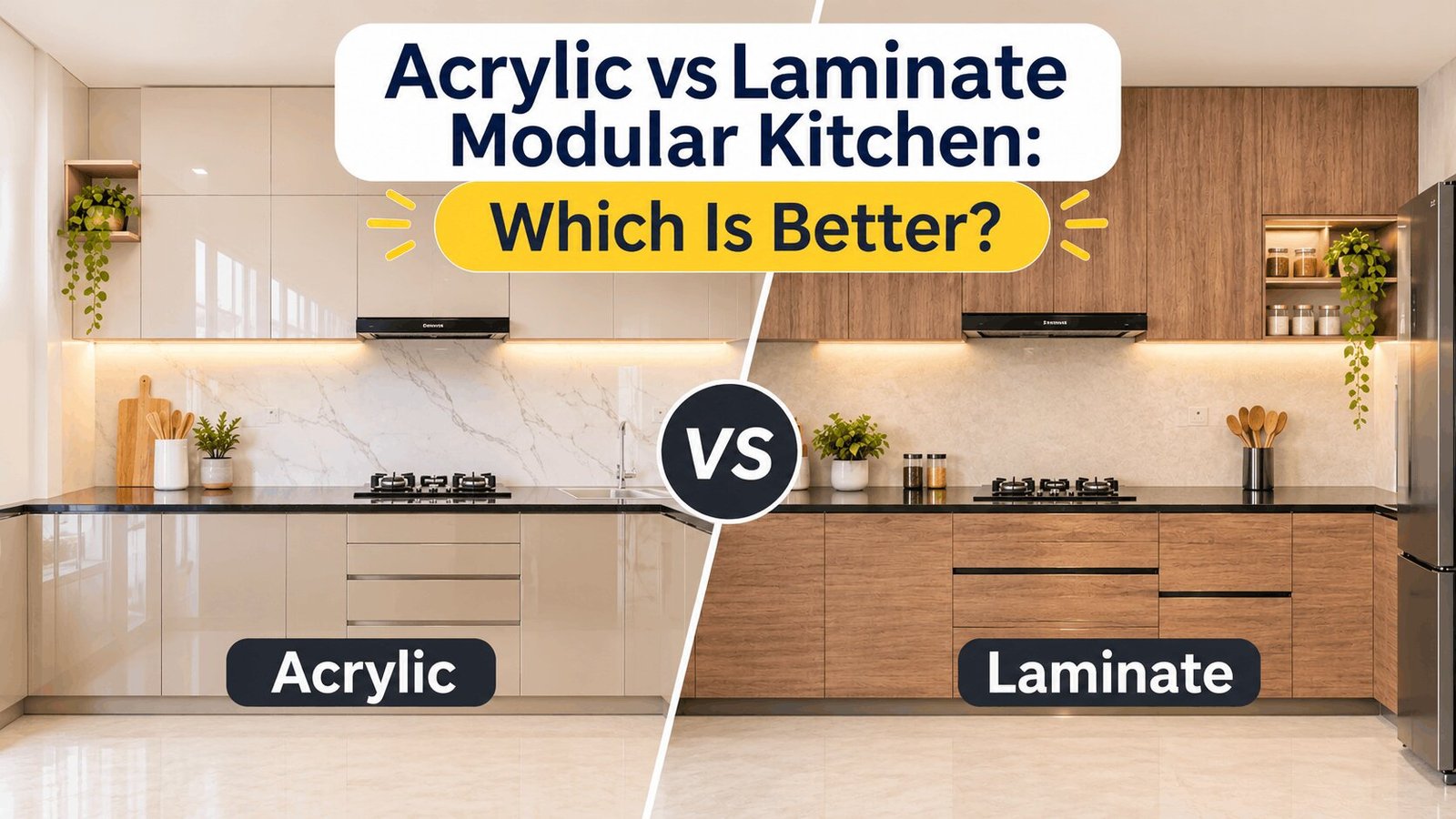
Choosing the right finish for kitchen cabinets is an important decision when planning a modular kitchen. The cabinet finish affects the kitchen’s appearance, maintenance, durability, cleaning requirements and overall cost.
Two commonly considered options are acrylic and laminate finishes.
Acrylic is generally associated with a smooth, high-gloss appearance, while laminate is available in a wide range of colours, textures and finishes, including both matte and glossy options.
So, which one is better for a modular kitchen?
The answer depends on your budget, design preferences, cooking habits, maintenance expectations and the type of appearance you want.
In this guide, we compare acrylic vs laminate modular kitchen finishes across the factors that matter when designing a kitchen.
What Is an Acrylic Modular Kitchen?
Acrylic is a smooth decorative surface material commonly used as a cabinet finish in modular kitchens.
Acrylic kitchen surfaces are often selected for their:
- High-gloss appearance
- Smooth finish
- Reflective surface
- Modern look
- Wide colour selection
Acrylic finishes can create a sleek and contemporary appearance, particularly when used with modern cabinet designs.
The actual quality and performance depend on the specific acrylic product, substrate, thickness and manufacturing process.
What Is a Laminate Modular Kitchen?
Laminate is a decorative surface material used on kitchen cabinets and other interior surfaces.
It is available in many designs, including:
- Wood textures
- Solid colours
- Stone-inspired patterns
- Matte finishes
- Gloss finishes
- Textured surfaces
This variety makes laminate a flexible choice for different kitchen styles and budgets.
As with acrylic, the quality and performance depend on the specific product and installation.
Acrylic vs Laminate Modular Kitchen
| Feature | Acrylic | Laminate |
| Appearance | Smooth, high-gloss appearance is common | Available in matte, gloss and textured finishes |
| Surface reflection | Generally high | Depends on selected finish |
| Design variety | Wide range of colours | Very wide range of colours, patterns and textures |
| Fingerprints | Can be more visible on glossy surfaces | Depends on colour and finish |
| Cleaning | Generally easy with suitable cleaning methods | Generally easy with suitable cleaning methods |
| Scratch visibility | Marks can be visible on smooth glossy surfaces | Depends on laminate type, colour and texture |
| Maintenance | Regular wiping may be needed | Generally practical for everyday use |
| Cost | Can be higher depending on product | Available across a broad range of price points |
| Design style | Sleek and contemporary | Versatile, from traditional to modern |
| Finish options | Commonly high-gloss | Matte, gloss, woodgrain and textured options |
| Indian kitchen suitability | Suitable when correctly specified | Suitable for a wide range of kitchens |
The actual performance should always be evaluated using the specific product specification rather than the material name alone.
Acrylic vs Laminate: Appearance
Appearance is one of the most noticeable differences between the two.
Acrylic Finish
Acrylic is commonly chosen when homeowners want a sleek, reflective and premium-looking cabinet surface.
It can work particularly well with:
- Modern kitchens
- Minimalist designs
- Contemporary apartments
- Bright colour schemes
- High-gloss interiors
The reflective surface can also interact strongly with kitchen lighting.
Laminate Finish
Laminate provides more flexibility in terms of appearance.
You can find laminate surfaces in:
- Matte
- Gloss
- Woodgrain
- Stone-effect
- Solid colours
- Textured patterns
This makes laminate suitable for both modern and more traditional kitchen designs.
Acrylic vs Laminate: Design Options
If design flexibility is your main priority, laminate offers a broad selection of colours, textures and patterns.
Acrylic is particularly attractive if you prefer a clean, smooth and glossy appearance.
Therefore:
Acrylic → sleek and reflective appearance
Laminate → broader range of textures and visual styles
However, the exact range depends on the manufacturer’s current collection.
Acrylic vs Laminate: Gloss and Matte Finishes
One important point is that laminate does not mean matte only.
Laminate is available in different surface finishes, including glossy and matte options.
Acrylic is widely associated with high-gloss surfaces, although product ranges can differ.
Therefore, if you are comparing the two materials, compare the actual samples rather than assuming that one will always be glossy and the other matte.
Acrylic vs Laminate: Cleaning and Maintenance
Both acrylic and laminate surfaces can be relatively easy to clean when maintained correctly.
Acrylic
Because glossy acrylic surfaces can show fingerprints, smudges and water marks, regular wiping may be required.
Use a soft cloth and cleaning method recommended by the manufacturer.
Avoid abrasive materials that could damage the surface.
Laminate
Laminate is also generally easy to maintain.
Food splashes, dust and other surface marks can usually be removed using an appropriate soft cloth and suitable cleaning method.
The exact cleaning procedure depends on the laminate product.
Acrylic vs Laminate: Fingerprints
Fingerprint visibility depends significantly on colour and surface finish.
Glossy acrylic surfaces can make fingerprints and smudges more noticeable, particularly darker colours.
Laminate can also show fingerprints on smooth glossy surfaces, while textured or matte laminates may make minor marks less visually prominent.
If fingerprint visibility is a concern, inspect actual samples before making a final decision.
Acrylic vs Laminate: Scratch Resistance
It is not accurate to assume that every acrylic surface is scratch-proof or every laminate surface is highly scratch-resistant.
Scratch resistance depends on:
- Product quality
- Surface construction
- Colour
- Texture
- Usage
- Cleaning method
- Installation
- Manufacturer specifications
Some scratches may also be more visible on highly reflective surfaces.
For a busy kitchen, ask the supplier about the specific product’s scratch-resistance characteristics and warranty.
Acrylic vs Laminate: Durability
Both materials can be used successfully in modular kitchens.
However, durability depends on much more than the decorative surface.
The overall cabinet performance also depends on:
- Core/substrate material
- Edge treatment
- Adhesive quality
- Hardware
- Cabinet construction
- Installation quality
- Moisture exposure
- Everyday usage
Therefore, when comparing acrylic and laminate, ask about the complete cabinet specification rather than only the outer finish.
Acrylic vs Laminate for Indian Kitchens
Indian kitchens can experience frequent cooking, steam, oil splashes, spices and regular handling.
For this reason, practical maintenance should be considered alongside appearance.
Acrylic can be attractive for homeowners who want a sleek modern kitchen and are comfortable with regular wiping of visible marks.
Laminate can be a practical choice for homeowners who want a broad selection of designs and finishes across different price ranges.
Good ventilation, proper cleaning and suitable cabinet construction are important regardless of the selected finish.
Acrylic vs Laminate: Which Is Better for Small Kitchens?
Both can work in small kitchens.
Acrylic’s reflective surface can help create a brighter visual effect when combined with suitable lighting.
Laminate can also work well, particularly when lighter colours and appropriate cabinet designs are used.
For a small kitchen, consider the complete design:
- Cabinet colour
- Lighting
- Countertop
- Backsplash
- Storage
- Kitchen layout
- Visual clutter
The finish alone does not determine whether a small kitchen will look spacious.
Acrylic vs Laminate: Cost
The cost difference is not fixed.
The final modular kitchen price depends on:
- Kitchen size
- Cabinet material
- Acrylic or laminate product
- Hardware
- Design complexity
- Countertop
- Accessories
- Installation
- Brand
Laminate is available across a broad range of price points, while acrylic can be positioned as a more premium cabinet finish depending on the product.
Instead of comparing only the finish price, compare the complete quotation and material specification.
Acrylic vs Laminate: Which Is More Premium?
Acrylic can create a premium appearance because of its smooth and reflective surface.
However, a premium-looking kitchen is not determined by the finish alone.
Factors such as:
- Cabinet construction
- Hardware
- Edge finishing
- Countertop
- Lighting
- Installation
- Design quality
all contribute to the final result.
A high-quality laminate kitchen can look equally sophisticated when properly designed.
Pros and Cons of Acrylic Modular Kitchen
Advantages
- Sleek high-gloss appearance
- Strong light reflection
- Modern visual style
- Smooth surface
- Available in many colours
- Can create a premium contemporary look
Disadvantages
- Fingerprints may be more visible
- Smudges and water marks can be noticeable
- Glossy surfaces require regular wiping
- Scratches may be visually noticeable depending on the surface
- Premium acrylic products can increase project cost
Pros and Cons of Laminate Modular Kitchen
Advantages
- Wide variety of designs
- Available in matte, gloss and textured finishes
- Wood and stone-inspired options
- Available across different price ranges
- Practical for everyday kitchen use
- Easy to coordinate with different interior styles
Disadvantages
- Quality varies significantly between products
- Some surfaces may show scratches or marks
- Lower-quality products may not provide the same appearance or performance as premium options
- Seam and edge quality depends on manufacturing and installation
Acrylic vs Laminate: Which One Should You Choose?
Choose acrylic if you prioritize:
- High-gloss appearance
- Sleek modern design
- Reflective surfaces
- Contemporary interiors
- Premium visual appeal
Choose laminate if you prioritize:
- Design variety
- Matte or textured options
- Woodgrain appearance
- Practical everyday use
- More flexibility across price ranges
There is no universal winner.
The right choice depends on your home’s requirements and the specific product being considered.
Can Acrylic and Laminate Be Combined?
Yes.
A modular kitchen can combine different finishes to create contrast.
For example:
- Acrylic upper cabinets + laminate lower cabinets
- Laminate base cabinets + acrylic accent cabinets
- Woodgrain laminate + solid-colour acrylic
- Matte laminate + glossy acrylic
A combination can be useful when you want a premium visual accent without using one finish throughout the entire kitchen.
However, colours and textures should be coordinated carefully.
Acrylic vs Laminate for Different Kitchen Styles
Modern Kitchen
Acrylic can work well with sleek contemporary designs.
Minimalist Kitchen
Both simple acrylic and plain laminate finishes can work effectively.
Wooden Kitchen
Woodgrain laminate can create a natural appearance.
Small Apartment Kitchen
Either material can work depending on colour, lighting and layout.
Family Kitchen
Laminate can offer a wide range of practical finishes, while acrylic can be selected when a glossy contemporary appearance is preferred.
How to Choose Between Acrylic and Laminate
Before finalizing your kitchen finish, consider these factors.
1. Check Actual Samples
Do not select the finish only from a catalogue or digital image.
View physical samples under lighting similar to your kitchen.
2. Consider Your Budget
Compare the complete cabinet quotation rather than just the surface material.
3. Think About Maintenance
Consider how much time you want to spend wiping fingerprints and visible marks.
4. Check the Cabinet Core
Ask what material is being used underneath the decorative finish.
5. Ask About Warranty
Understand what is covered and for how long.
6. Check Hardware
Hinges, drawer channels and other hardware contribute significantly to kitchen performance.
7. Consider Your Kitchen Lighting
Glossy surfaces can reflect both natural and artificial light.
Common Mistakes When Choosing Acrylic or Laminate
- Choosing Only by Appearance: The most attractive finish may not be the most practical for your household.
- Ignoring the Cabinet Core: The decorative surface is only one part of the cabinet.
- Not Checking Samples: Colours and finishes can look different in actual kitchen lighting.
- Assuming Expensive Means Better: Compare specifications, construction and warranty rather than price alone.
- Ignoring Edge Finishing: Edges are important for both appearance and long-term performance.
- Forgetting Maintenance: Think about fingerprints, oil splashes, cleaning frequency and everyday use.
How Anupam Kitchen Can Help With Finish Selection
Choosing between acrylic and laminate should be part of the overall modular kitchen planning process.
Anupam Kitchen can be considered when planning a modular kitchen according to:
- Kitchen size
- Layout
- Storage requirements
- Cabinet materials
- Finish preferences
- Countertop
- Hardware
- Budget
Before finalizing the project, compare actual samples and confirm the specifications of the selected acrylic or laminate product.
A well-planned kitchen should balance appearance, functionality, maintenance and long-term usability.
Acrylic vs Laminate Modular Kitchen: Quick Decision Guide
| If Your Priority Is… | Consider |
| High-gloss modern appearance | Acrylic |
| Wide range of textures | Laminate |
| Woodgrain look | Laminate |
| Reflective surface | Acrylic |
| Matte finish options | Laminate |
| Contemporary premium appearance | Acrylic |
| Flexible design choices | Laminate |
| Lower-to-mid budget options | Laminate |
| Easy everyday maintenance | Both, depending on product |
| Low fingerprint visibility | Matte/textured options |
This table is a general guide. The specific product quality and finish should always be checked before purchase.
Frequently Asked Questions
Q1. Is acrylic better than laminate for a modular kitchen?
Not necessarily. Acrylic is often preferred for a sleek, glossy appearance, while laminate offers a wider variety of finishes and price options. The better choice depends on your priorities.
Q2. Which is more durable, acrylic or laminate?
Durability depends on the specific product, cabinet construction, substrate, installation and usage. Neither material should be considered universally more durable without comparing specific products.
Q3. Is an acrylic kitchen easy to clean?
Yes, acrylic surfaces can generally be cleaned with appropriate methods. However, glossy surfaces may show fingerprints, smudges and water marks more clearly.
Q4. Is laminate good for Indian kitchens?
Yes. Laminate is available in many finishes and can be a practical choice for Indian kitchens when the appropriate product and cabinet construction are selected.
Q5. Which is more expensive, acrylic or laminate?
There is no fixed price difference. Laminate is available across many price levels, while acrylic products can be positioned at a higher price depending on their specifications.
Q6. Does an acrylic kitchen show fingerprints?
Glossy acrylic surfaces can show fingerprints and smudges more visibly, particularly in darker colours.
Q7. Can laminate be glossy?
Yes. Laminate is available in both matte and glossy finishes, along with various textures and patterns.
Q8. Which is better for a small kitchen, acrylic or laminate?
Both can work. Acrylic can reflect light and create a brighter visual effect, while light-coloured laminate can also make a compact kitchen feel open and organized.
Q9. Can acrylic and laminate be used together?
Yes. Combining the two can create contrast between different cabinet sections, provided the colours and finishes are coordinated.
Q10. How do I choose between acrylic and laminate?
Compare the actual samples, finish, maintenance requirements, cabinet construction, hardware, warranty and total cost. Then choose according to your design preferences and everyday kitchen usage.
Conclusion
The choice between an acrylic vs laminate modular kitchen depends on more than appearance.
Acrylic can be a good option if you want a sleek, smooth and reflective modern kitchen. Laminate can be a versatile choice when you want a wider selection of colours, textures, woodgrain patterns and finishes across different price ranges.
For Indian homes, consider cooking frequency, oil and food splashes, cleaning habits, lighting and the amount of daily use.
Most importantly, compare the complete cabinet specification, not just the surface finish. The cabinet core, edge treatment, hardware, installation quality and warranty all contribute to the performance of the finished kitchen.
Before making the final decision, view actual material samples and compare them under your kitchen’s lighting.
The right combination of material + finish + cabinet construction + hardware + layout can create a modular kitchen that looks attractive and remains practical for everyday use.